By: Krystle Boyajian
In the dark damp basement of basement of a fraternity house, college students dance to the beat of rap music. The students are sweaty, the music is loud, and the bar is busy. Undergraduates shove their way to the front of the line for a red Solo cup full of whatever they can get their hands on.
Once, these Solo cups were filled with jungle juice, but now, students are more likely to get cups filled with beer, wine, and hard seltzer.
Students say they have been noticing the change since September, and some are disappointed. But, Haylee, a Boston University student and sorority member, isn’t upset over the switch. She says that she feels safer at parties, “primarily because most wine and beer can’t be tampered with but jungle juice can be.”
The change came from the North American Inter-fraternity Conference which hopes to prevent alcohol poisoning at fraternity events.
In September 2018, the NIC, which rules 6186 fraternity chapters in North America, voted to ban hard alcohol in all of their fraternity houses. This ban prohibits everyone in the house, even adults over the age of 21, from possessing or drinking alcohol with a 15% or higher alcohol content.
The ban was created to address long standing alcohol related problems in Greek Life, alcohol related deaths, sparked by Timothy Piazza’s death at Penn State in February 2017.
In the past ten years, 22 students, including Timothy, have died due to alcohol consumption at fraternities. The 22 deaths have come from various situations such as overconsumption at a party or hazing incidents, but, they all have one thing in common besides fraternities, hard alcohol.
The problem with hard alcohol is that students binge drink which gets them drunk fast and dangerously. Binge drinking is defined by the National Institute on Alcohol Abuse and Alcoholism as drinking four or more drinks within an hour for a women and five or more for a man.
According to the NIAAA, the first six weeks of freshman year are the most dangerous times of a college student’s life concerning alcohol. But, students who are in a fraternity or a sorority binge drink at a high rate throughout all their years, according to their studies.
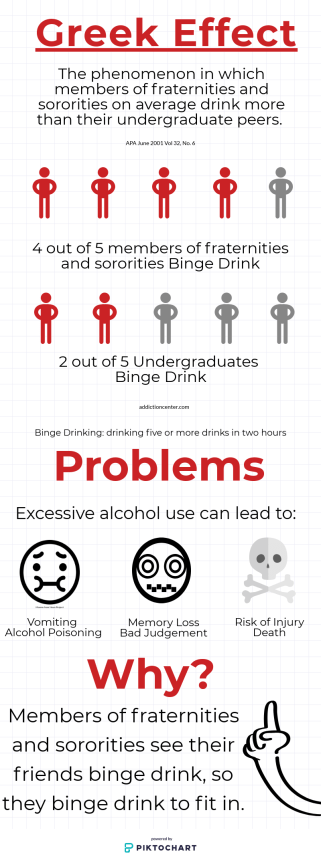
A 2006 study, form the University of Missouri described a phenomenon called the greek effect. The Greek Effect is when members of fraternities and sororities believe everyone else is binge drinking so they decide to binge drink as well creating a cycle of over indulgence and danger.
The Addiction Center which runs rehabs across the country, states on their website that four out of five (80%) students involved in greek life binge drink, compared to the two out of five (40%) binge drinkers among average undergraduate students.
This has been a long standing problem in greek life, forever immortalized in movies such as Animal House, and students take notice.
“…it’s the fear of missing out and we have that as a society on instagram,” said Haylee “You see other people doing this and you don’t want to be the lame one.”
Colleges and Greek councils have previously tried to address drinking the issue with interventions, but some studies have found that they had little to no effect on the rate of consumption at fraternity parties.
The American Psychological Association published a study showing this in May of 2016. The study tracked the efficacy of alcohol interventions for Greek Life from 1987 to 2014. They found that alcohol interventions had minimal effects on the reduction of alcohol consumption.
The methods used in these interventions include tips on how to drink safely or how to set goals to follow safe drinking habits. But, these interventions have failed to change students’ opinions on alcohol, and hence fail to change their drinking habits, according to their research.
Despite the minimal efficacy, some colleges, such as Boston University, still require alcohol intervention programs for incoming students.
Boston University’s AlcoholEdu program was created in June 2013, three months after the death of Anthony Barksdale II at BU’s Sigma Alpha Mu chapter. Five years later the program is still in place but some students say they ignored it and know others who ignored it as well.

Kate, a senior at Boston University, said that, “for some people it may be (effective) but a lot of people choose to ignore it.”
Haylee, said that students who drank in high school already feel confident in their ability to drink. While these students may binge drink and make dangerous decisions, since they feel comfortable with their decisions BU’s intervention fails to change their minds.
Some Universities such as Dartmouth College and Stanford University banned alcohol prior to the NIC ruling, but saw minimal results according to a survey published by the Dartmouth.
Since the NIC’s ban will reach 6196 chapters both on and off college campuses, some say it may be the solution that colleges have been hoping to find for over 30 years.
By limiting students’ access to hard alcohol the NIC may be able to reach the root of the college drinking problem, but members of greek life don’t believe the problem is limited to them.
“It’s everyone from 18 to like 26,” Taylor a member of greek life said, “(Fraternities are) just the ones with houses throwing parties.”
Taylor went on to explain that the majority of people that she sees attending parties or even at college bars are binge drinking. But for students under 21 a fraternity party can be the easiest way to get alcohol so it isn’t as much of a greek life drinking issue as it is a supplying the campus with alcohol issue.
Since the NAIFC’s ban was passed, people have been commenting online about their worries about the ban not fixing the root of greek life’s drinking problem. These people describe a pervasive Animal House culture that permeates greek life, but members of sororities and fraternities aren’t concerned with the worries.
“People assume that this is going on (from movies) but behind closed doors there’s a lot more than people drinking.” Haylee said, “ I think there’s a mindset that all we do is drink. We have philanthropy events and sisterhood events, but all people think of is drinking.”
 Krystle Reine Boyajian
Leave a comment